
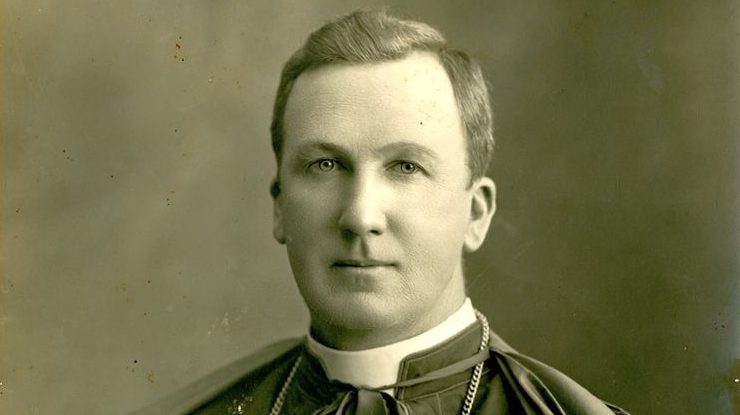
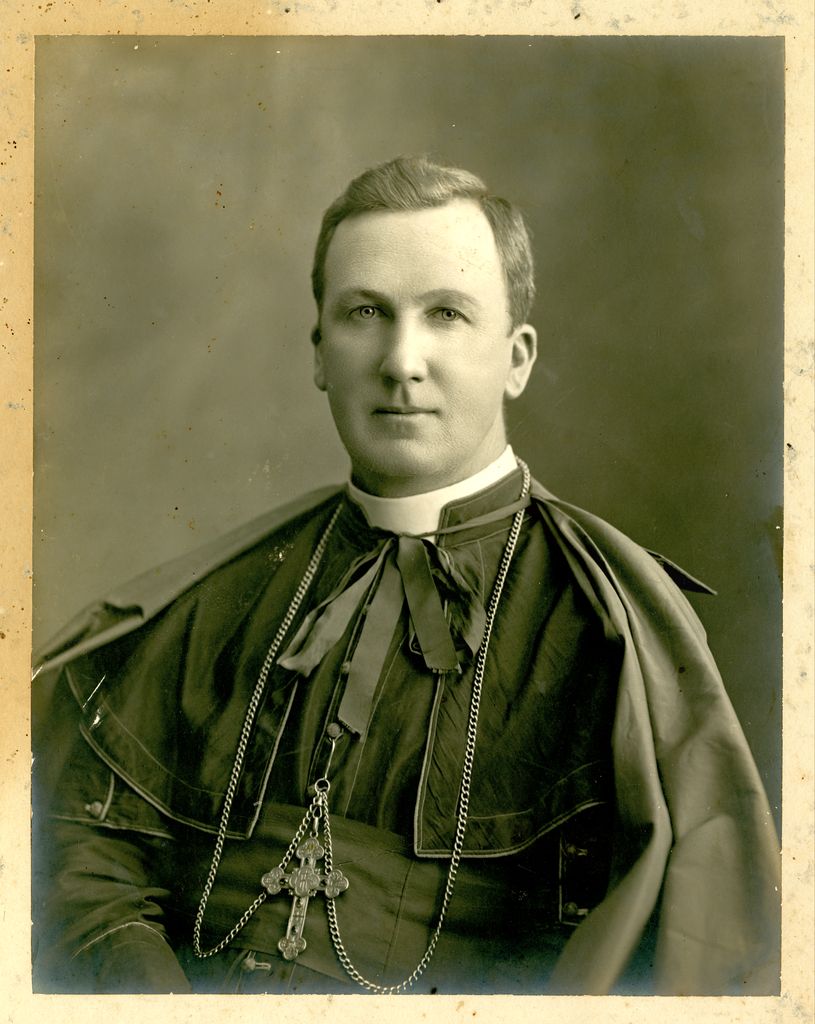
For almost half a century, Archbishop James Duhig was one of the most recognisable and influential figures in Queensland public life.
Irish-born, energetic, ambitious and blessed with an extraordinary capacity for getting things done, Duhig led the Catholic Archdiocese of Brisbane from 1917 until his death in 1965. During that time he helped transform the physical and institutional landscape of Catholic Queensland, overseeing an enormous programme of church, school, hospital and charitable development.
It was a record that earned him the affectionate nickname “Duhig the Builder”.
Sir James Duhig was born on 2 September 1871 at Killila, near Broadford in County Limerick, the youngest of seven children of John and Margaret Duhig. His early life reflected the difficult experience of many Irish families of the period. Following his father’s death, the family spent time in Middlesbrough in England before returning temporarily to Ireland, where they were eventually evicted from their holding.
Like so many Irish families of the nineteenth century, the Duhigs joined the great migration overseas.
James arrived in Brisbane with his mother and other family members in April 1885. The family settled in the growing northern suburbs, and the young James attended St Joseph’s College, Gregory Terrace, run by the Irish Christian Brothers.
At first, there was little to suggest that he would become one of Queensland’s most prominent churchmen. He worked in clerical employment and was involved in parish and youth activities at Wooloowin. His abilities, however, attracted the attention of Brisbane’s Archbishop Robert Dunne, himself an Irishman, who encouraged the young Duhig towards the priesthood.
In 1891, Duhig travelled to Rome to study at the Irish College and the Urban University of Propaganda Fide. He was ordained a priest in Rome on 19 September 1896 and returned to Queensland the following year.
His rise was rapid.
After serving as a curate in Ipswich and gaining valuable experience in the administration of a large and far-reaching parish, he became administrator of St Stephen’s Cathedral in Brisbane in 1905. Later that same year, at only 34 years of age, he was appointed Bishop of Rockhampton.
In 1912 he returned to Brisbane as coadjutor to the ageing Archbishop Robert Dunne and, following Dunne’s death, succeeded him as Archbishop of Brisbane in 1917.
He would remain in the position for the next 48 years.
“Duhig the Builder”
It was in Brisbane that Duhig left his most visible mark.
He believed strongly that the Catholic Church should be close to its people. That meant churches within reach of local communities, parish schools for Catholic children and charitable institutions where they were needed.
He created new parishes, encouraged the arrival of religious orders and greatly expanded Catholic education. Under his leadership, the archdiocese brought in numerous new communities of priests, brothers and sisters, greatly increasing the Church’s capacity to establish schools, hospitals and other institutions.
Over the course of his long episcopate, Duhig was responsible for the construction of more than 400 major buildings, including churches, schools, hospitals and charitable institutions. It was an extraordinary achievement and one that remains visible across Brisbane today.
Education was particularly important to him. Duhig believed Catholic families should have access to a complete education system, from parish primary schools through to secondary and tertiary education. He encouraged the expansion of Catholic secondary schooling and supported university education, serving on the Senate of the University of Queensland for almost half a century.
His vision was not simply religious. He saw education as a means of social advancement for Catholic families, many of whom had Irish roots and whose parents and grandparents had arrived in Australia with comparatively little wealth or influence.
The great cathedral that was never built
Duhig’s greatest dream was also his greatest disappointment.
He envisaged a magnificent Cathedral of the Holy Name in Fortitude Valley, a building on a scale that would proclaim the confidence and growing importance of Brisbane’s Catholic community.
The project was enormously ambitious. The planned cathedral was intended to be one of the great church buildings of its era and would have transformed the entrance to the Valley.
In 1928, a spectacular ceremony was held to lay the foundation stone, attended by an estimated 35,000 people. For Duhig and his supporters, it was to be the centrepiece of a new Catholic Brisbane.
But history intervened.
The onset of the Great Depression devastated the financial assumptions behind the project, including investments that Duhig had hoped would help finance it. Construction never progressed beyond the early stages and the cathedral was never completed.
Today, the story of the Holy Name Cathedral remains one of Brisbane’s great architectural what-ifs — a reminder of the extraordinary scale of Duhig’s ambitions.
An Irishman — and an Australian
Although Irish by birth and proud of his heritage, Duhig’s relationship with Irish politics was more complex than that of some other prominent Irish-Australian churchmen.
He did not share the strongly nationalist approach associated with Melbourne Archbishop Daniel Mannix. During the turbulent years surrounding the Easter Rising and the Irish struggle for independence, Duhig criticised British repression but also condemned the 1916 rebellion. He was capable of holding a distinctly Irish attachment alongside a strong sense of loyalty to Australia and the British Empire.
His interests were broad and extended well beyond the Church.
Duhig spoke regularly on issues affecting Queensland’s development, including education, land settlement, town planning and cultural life. He was a supporter of the University of Queensland, a patron of the arts and an active figure in civic life.
He also promoted greater cooperation between Christian denominations at a time when sectarian divisions could still be deeply felt in Australian society.
In later years, he supported the settlement and integration of post-war migrants, particularly Italians, reflecting the changing face of Australian Catholicism.
A Queensland institution
Duhig’s influence was recognised far beyond the Catholic Church.
He received honorary degrees from the universities of Queensland and Ottawa and from the National University of Ireland. He was appointed CMG in 1954 and, in 1959, became the first Roman Catholic archbishop in Australia to accept a knighthood, becoming Sir James Duhig KCMG.
When he died at his New Farm home on 10 April 1965, aged 93, he had spent almost 60 years as a bishop and archbishop and 48 years as Archbishop of Brisbane.
He was buried in the vault of St Stephen’s Cathedral.
For generations of Queensland Catholics, particularly those from Irish families, Duhig was simply part of the landscape of their lives. His name appeared on schools, colleges, buildings and institutions, while the churches and schools created during his long leadership became permanent landmarks in suburbs across Brisbane.
His legacy was not without controversy, and his grandest project — the Holy Name Cathedral — remained unfinished. But there is little doubt about the scale of his influence.
James Duhig arrived in Brisbane as a teenage Irish immigrant at a time when Queensland itself was still a young colony. By the time of his death eight decades later, he had helped build one of the largest and most developed Catholic institutional networks in Australia.
“Duhig the Builder” left his mark on Queensland — in brick and stone, in schools and hospitals, and in the generations of families who passed through the institutions he helped create.
Sir James Duhig remains one of the most significant Irish-born figures in Queensland’s religious and civic history.

