

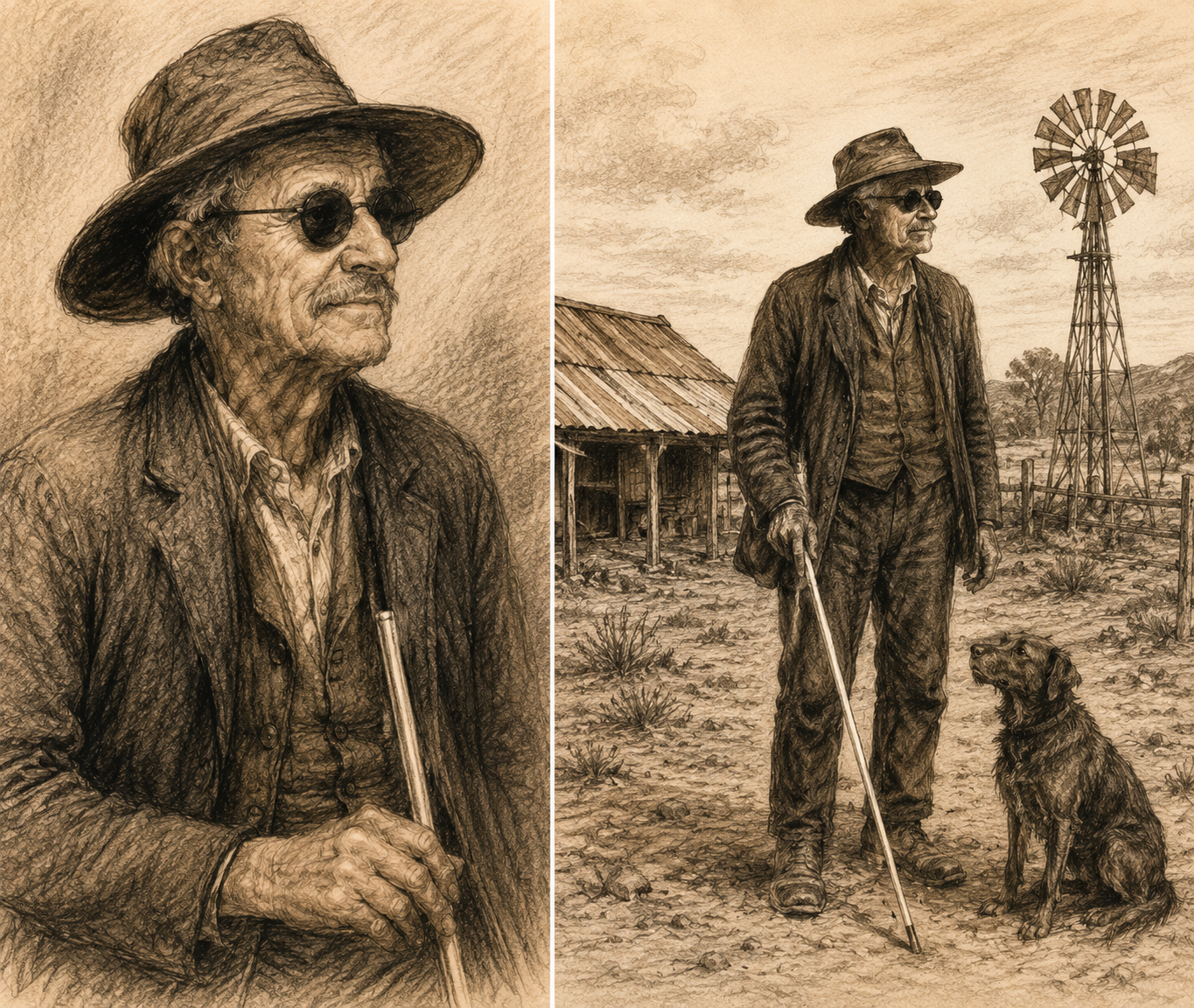
Buried in Brisbane, the “Blind Poet” Jack Mathieu turned hardship into art, transforming memories of shearing sheds, droving tracks and bush life into verses that earned him comparisons with Henry Lawson and Banjo Paterson.
Among the graves of Brisbane’s historic cemeteries lies the final resting place of one of Australia’s most remarkable bush poets — a man who lost his sight at only 22 but went on to create a body of work celebrating the people and landscapes of rural Australia.
John Baptiste Mathieu, better known as Jack Mathieu, was born in Victoria in the early 1870s to a French father and an Irish mother.
As a young man, Mathieu travelled through northern and western Queensland, working as a sailor, shearer and drover. It was during these years on the road, sleeping beneath the stars, travelling dusty tracks and sharing stories around shearing sheds, that he found the inspiration for his writing.
The bush became his classroom.
The characters he met — shearers, station hands, drovers and the ordinary people of the outback — would later fill his poems and short stories. His writing captured the humour, hardships and humanity of life beyond the cities.
But Mathieu’s life changed dramatically when he became totally blind at the age of 22 while working in Queensland.
Rather than ending his ambitions, blindness forced him to find new ways to pursue them.
He returned to Brisbane, established a tea-selling business, married his wife Agnes, and continued developing his writing career. He lived at Junction Terrace, Annerley, a home that remained connected with the Mathieu family for decades.
Despite his disability, Mathieu became one of Queensland’s best-known literary figures. For about 40 years, his poetry and stories appeared in major publications including The Bulletin, The Brisbane Worker and The Australasian Worker. His bush poems brought him recognition well beyond Queensland, with some works even translated into French and published overseas.
Among his greatest achievements were his collections Backblock Ballads and Lignum Lyrics, published in 1928.
His work drew comparisons with the great names of Australian bush literature. Critics praised him as a poet of the outback, writing of the shearing shed, the bushman and the romance of western Queensland life — placing him alongside writers such as Henry Lawson and Banjo Paterson.
Mathieu’s friendship with Lawson, who also had Irish heritage, was one of the notable literary connections of his life. The two met during a shearing expedition near Bourke, New South Wales, and developed a lifelong friendship. He was also associated with fellow writer Steele Rudd, creator of the famous On Our Selection stories.
The friendship with Lawson was particularly fitting. Both writers were drawn to the lives of ordinary Australians — the workers, families and travellers who built communities across the inland.
Mathieu also became a foundation member of the Queensland Authors’ and Artists’ Association, helping strengthen the state’s literary community.
When he died in Brisbane in 1949, tributes remembered not only his writing but his extraordinary personality.
One contemporary description called him “a man of outstanding personality” — someone whose character possessed that rare quality recognised by others but difficult to define. He was remembered as a writer, poet, short-story author and a remarkable conversationalist who maintained a love of life and the arts despite the challenges he faced.
Jack Mathieu’s story is one of resilience. A blind poet born of French and Irish heritage, shaped by Queensland’s vast landscapes, he preserved in verse the voices of the people he met along the bush tracks.
Today, his grave stands as a reminder that some of Queensland’s greatest stories belong not only to the famous names carved into history books, but also to those who quietly recorded the lives of others.

Picture: Jack Mathieu’s headstone at South Brisbane Cemetery. Credit: Friends of South Brisbane Cemetery

